Introduction
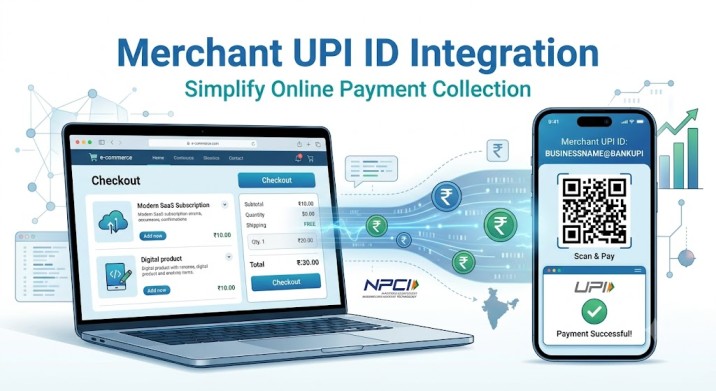
UPI has become one of the most convenient ways for businesses in India to accept digital payments. Customers can simply scan a QR code using a supported UPI app, verify the payment details and authorize the transaction.
For businesses operating websites, mobile apps, online stores and digital platforms, however, simply displaying a QR code is often not enough. Businesses also need to identify which customer placed an order, how much they were supposed to pay, and whether the payment was successfully completed.
This is where a Dynamic UPI QR Code can be useful.
Unlike a basic static QR code, a dynamic QR can be generated for a specific payment or order and can include information such as the merchant's UPI details, transaction reference and amount. NPCI's UPI documentation specifically describes QR-based merchant integration and identifies parameters such as the payee address, merchant name, transaction reference and amount for dynamic QR flows.
What Is a Dynamic UPI QR Code?
A Dynamic UPI QR Code is a QR code generated for a particular payment transaction.
Instead of displaying one permanent QR code for every customer, a business can generate a QR code associated with a specific order or payment request.
For example:
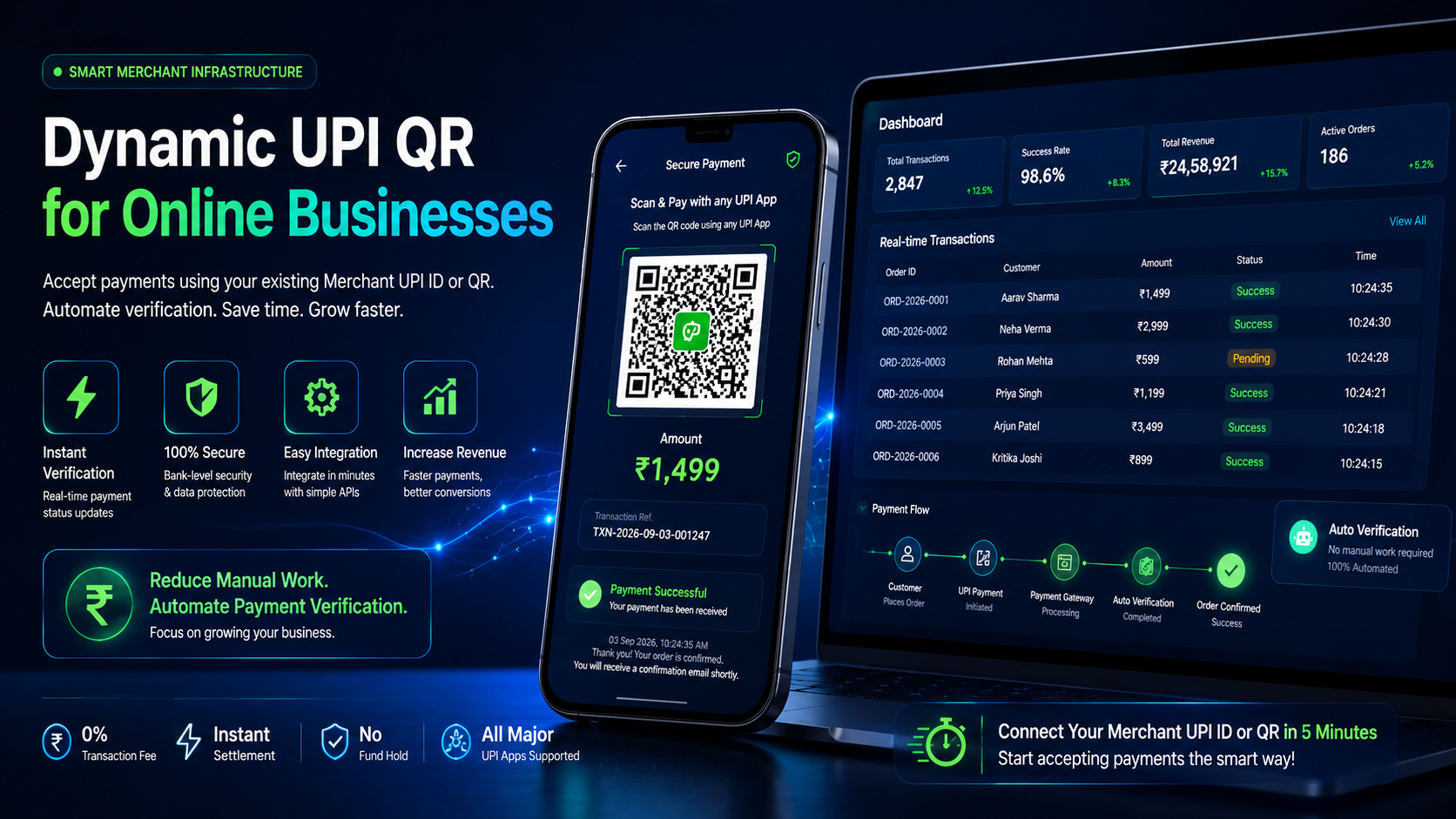
Customer places an order → Order value is ₹1,499 → System generates a payment QR → Customer scans QR → Payment is authorized → Transaction status is verified → Order is updated.
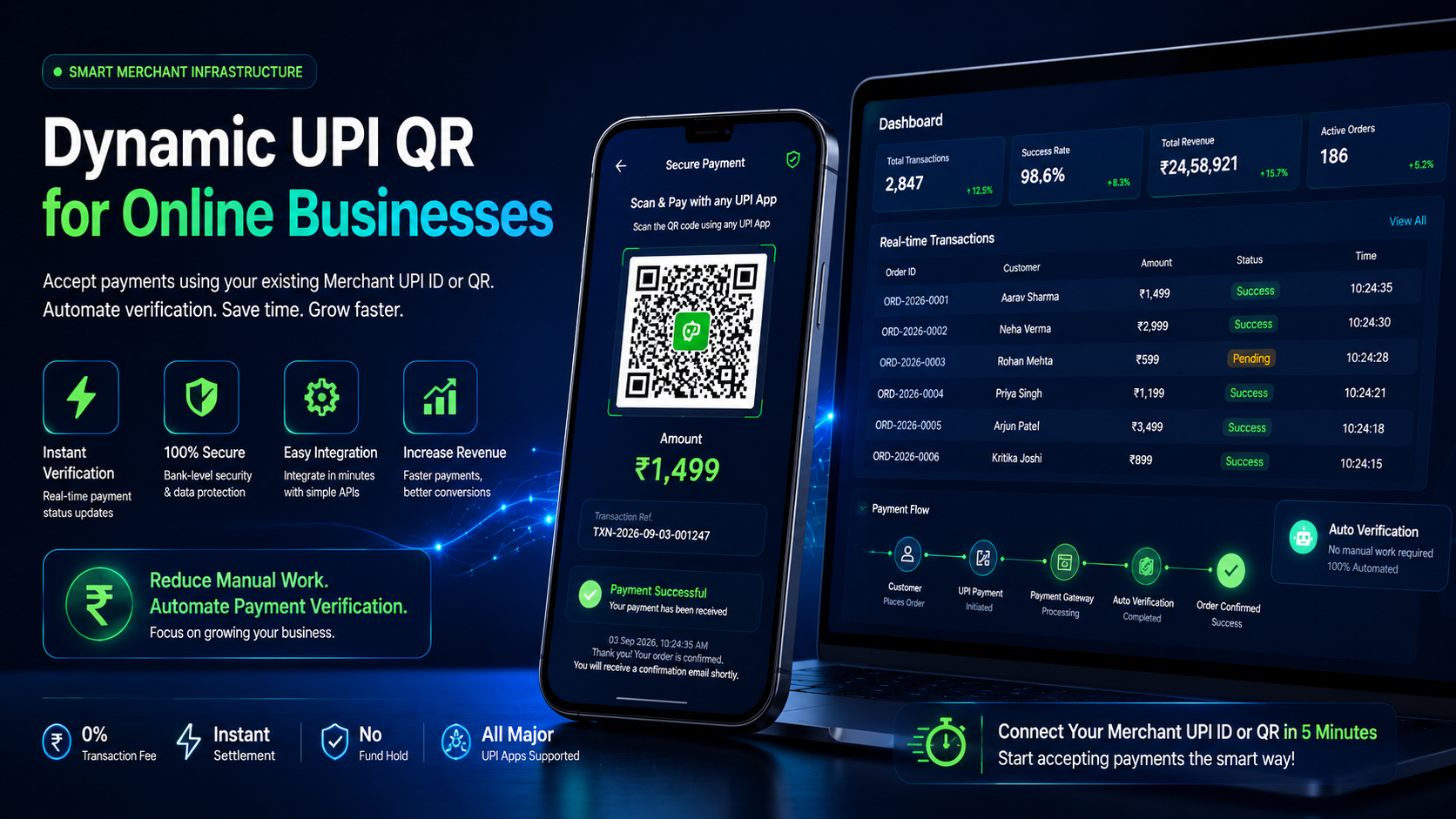
The QR can carry payment-related information such as the merchant's UPI address, merchant name, transaction reference and amount. NPCI's QR specifications distinguish dynamic QR from static QR and indicate that the amount in a dynamic QR transaction can be supplied as part of the payment information.
Dynamic QR Code vs Static QR Code
The biggest difference is how the payment information is generated and managed.
| Feature | Static UPI QR | Dynamic UPI QR |
|---|---|---|
| QR generation | Usually one permanent QR | Generated for a transaction/order |
| Amount | Customer may enter amount | Amount can be associated with payment |
| Order reference | Limited/manual | Can include transaction reference |
| Payment tracking | More manual | Better suited to automated reconciliation |
| Online checkout | Less flexible | More suitable |
| Multiple orders | Difficult to identify automatically | Individual payment references can help |
| Automation | Limited | Better suited for automated workflows |
NPCI documentation notes that static QR flows may lack a transaction reference, creating reconciliation challenges, while dynamic QR can include transaction-reference and amount parameters.
How Does a Dynamic UPI QR Code Work?
A typical dynamic QR payment workflow can be explained in six steps.
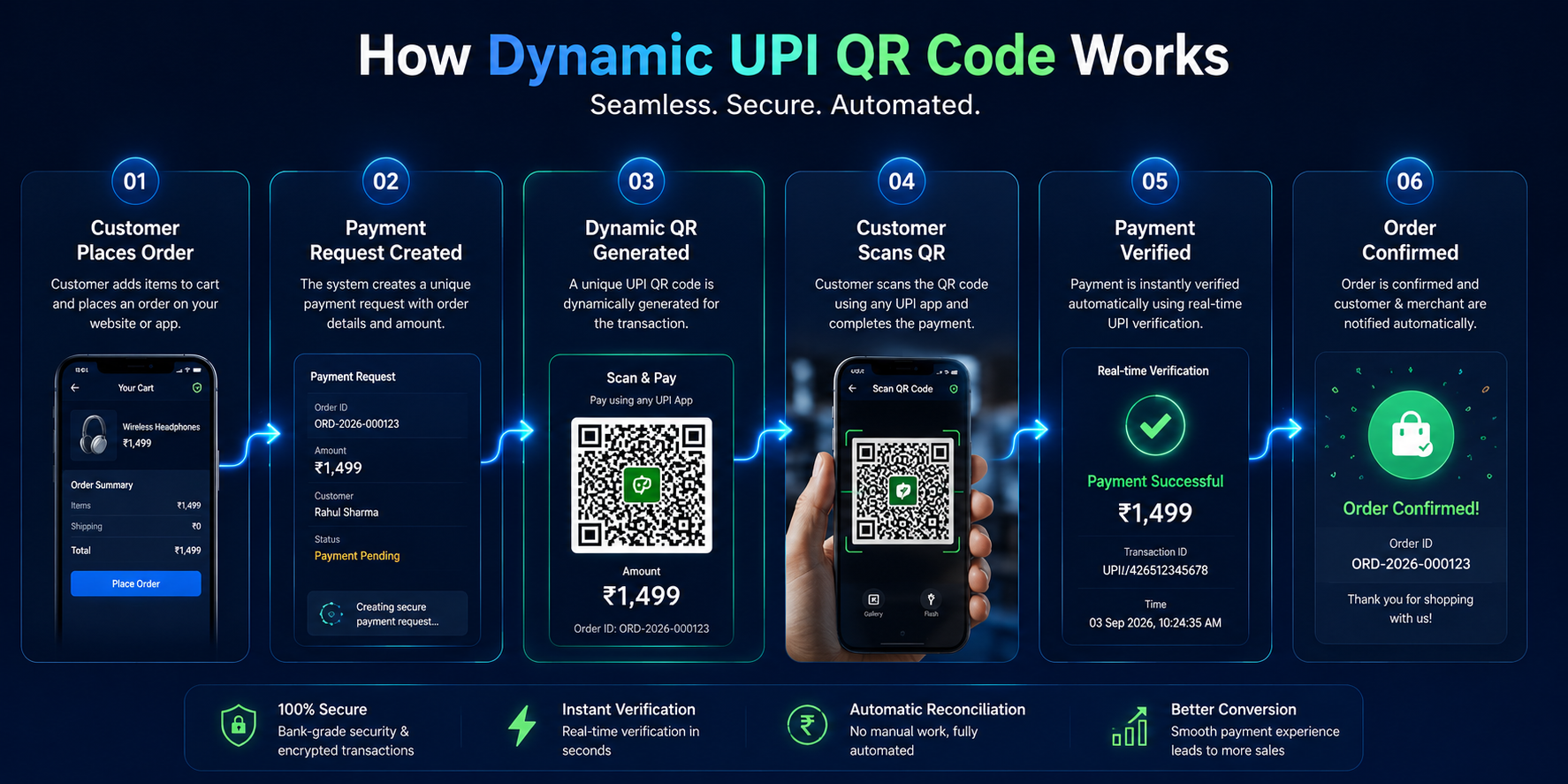
1. Customer Creates an Order
The customer visits a website or app and selects a product or service.
For example:
Order ID: ORD10245
Amount: ₹2,500
The website creates the order in its database.
2. Payment Request Is Created
The payment system generates the required UPI payment information for that particular transaction.
The information can include:
- Merchant UPI ID
- Merchant name
- Amount
- Transaction reference
- Other supported payment parameters
3. QR Code Is Generated
The payment information is converted into a QR code and displayed on the checkout page.
The customer can scan it using a supported UPI application.
UPI supports QR-based and intent-based merchant payment flows.
4. Customer Scans the QR
The customer scans the QR code and reviews the payment details in their UPI application.
They then authorize the payment using the authentication mechanism required by their UPI app/bank.
5. Transaction Status Is Received
After the payment is processed, the merchant's payment infrastructure can receive or check the transaction status.
This is an important part of automation because the website should not rely only on a customer saying that the payment was completed.
6. Order Status Is Updated
After successful verification, the website can automatically update the order.
For example:
Payment Pending → Payment Successful → Order Confirmed
This reduces the need for manually checking individual payments.
NPCI states that UPI merchant payments are designed for immediate payment transfer, subject to the applicable transaction and banking processes.
Why Do Businesses Use Dynamic UPI QR Codes?
1. Faster Payment Experience
Customers don't necessarily need to manually enter a UPI ID and amount. A properly configured dynamic QR can provide the payment information directly through the QR flow.
This can make checkout simpler and reduce unnecessary steps.
2. Better Payment Reconciliation
For businesses handling many transactions, identifying individual payments can become difficult.
A transaction reference associated with an order can make reconciliation easier.
For example:
Order: ORD10245
Reference: TXN784512
Amount: ₹2,500
This gives the business a clearer way to associate a payment with an order.
NPCI has specifically highlighted transaction-reference information as relevant to merchant reconciliation in dynamic QR implementations.
3. Reduced Manual Verification
Businesses that receive a large number of UPI payments may otherwise have to manually check:
- Bank transactions
- Payment screenshots
- UPI notifications
- Customer messages
- Order IDs
An automated payment-verification workflow can reduce this manual workload.
4. Useful for Websites and Mobile Apps
Dynamic QR payments can be incorporated into different digital checkout experiences, including:
- E-commerce websites
- Mobile applications
- Subscription platforms
- Service websites
- Digital products
- Online booking platforms
- SaaS applications
The exact implementation depends on the merchant's acquiring/payment infrastructure and technical setup.
Dynamic UPI QR Code for Online Businesses
For an online business, the payment process can look like this:
Website/App
↓
Customer Creates Order
↓
Payment Amount Generated
↓
Dynamic UPI QR Created
↓
Customer Scans QR
↓
UPI Payment Authorized
↓
Transaction Verified
↓
Order Automatically Confirmed
This creates a more connected payment workflow instead of treating the QR code as an isolated payment method.
Dynamic UPI QR Code and Payment Automation
A QR code itself does not automatically mean that the entire payment process is automated.
Businesses typically need additional technology around the QR payment flow for:
- Transaction identification
- Payment-status checking
- Order mapping
- Reconciliation
- Webhook/event handling where supported
- Failed-payment handling
- Duplicate-payment handling
- Refund workflows
This is why businesses looking to automate UPI payments should think beyond simply generating a QR code.
The goal should be to connect the payment → transaction → order → verification lifecycle.
How JaduPe Can Help Businesses Automate UPI Payments
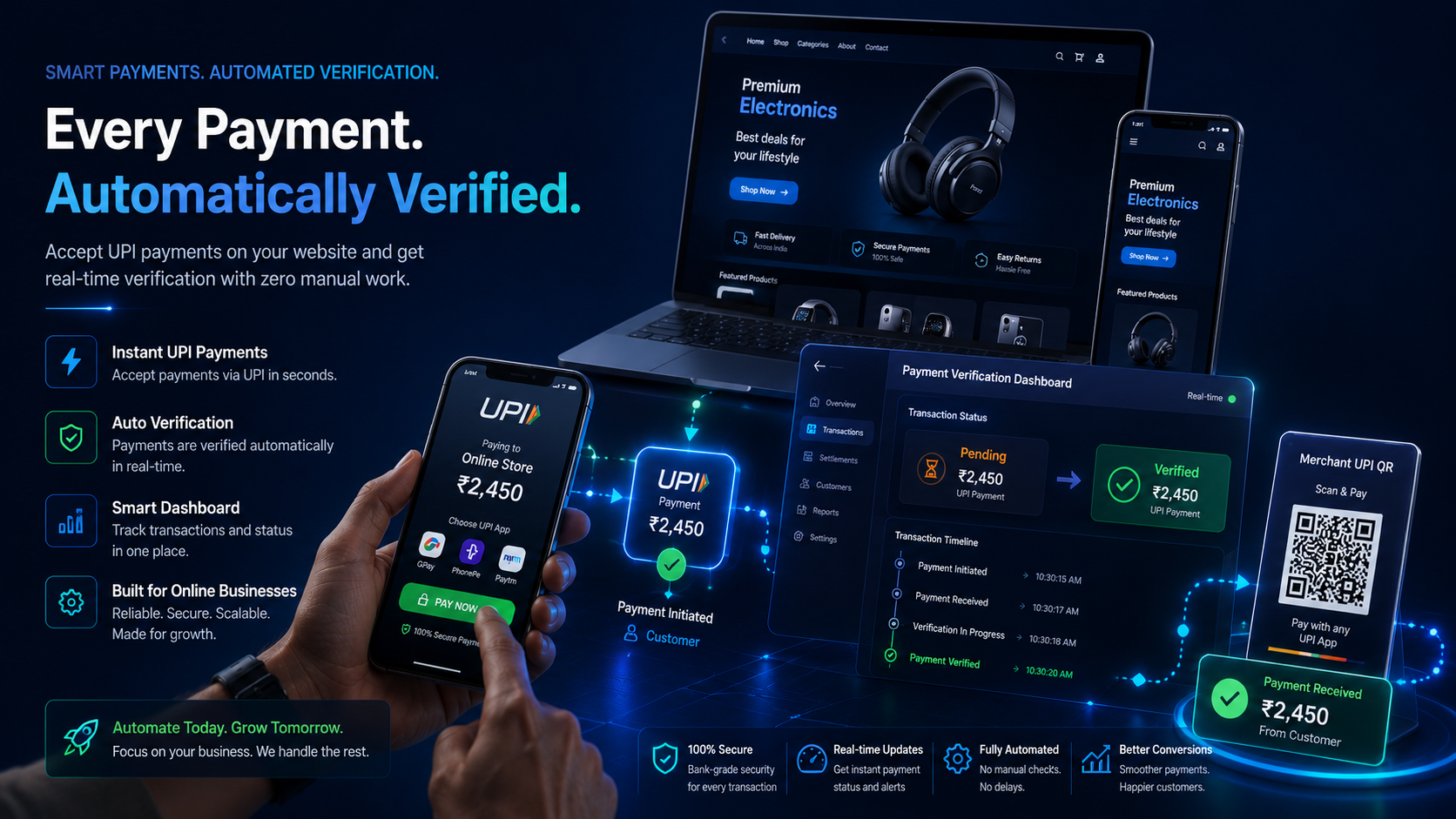
JaduPe provides smart merchant infrastructure designed to help online businesses connect their existing merchant UPI setup with payment automation technology.
Businesses can use technology such as dynamic QR generation and payment-status workflows to create a smoother payment experience across websites and applications.
The concept is simple:
Your Merchant UPI → Payment Automation Layer → Website/App → Payment Verification
This can help businesses reduce repetitive manual payment checking and create a more streamlined checkout experience.
Important: JaduPe should be positioned as merchant/payment automation technology rather than a bank or payment gateway. Businesses should use appropriate authorized merchant/acquirer arrangements for UPI acceptance.
Dynamic UPI QR Code for E-Commerce
Consider an online store selling a product for ₹1,999.
The customer reaches checkout and chooses UPI.
The system can create a payment request associated with:
Order ID: #SHOP4589
Amount: ₹1,999
Reference: SHOP4589TXN
A dynamic QR is displayed.
The customer scans it, completes the payment and the transaction is verified.
Once successful, the website can move the order from:
Payment Pending
to
Payment Successful
and continue with the fulfillment process.
This approach becomes particularly useful when a business processes hundreds or thousands of orders.
Benefits of Dynamic UPI QR for Businesses
⚡ Faster Checkout
Provide customers with a convenient QR-based payment experience.
🔄 Better Automation
Connect payment transactions with website or app workflows.
📊 Improved Reconciliation
Transaction references can help businesses match payments with orders.
🧾 Better Order Tracking
Payment information can be associated with individual orders.
👨💻 Less Manual Work
Reduce repetitive checking of screenshots and payment notifications.
📱 Mobile-Friendly
QR-based UPI payments work naturally with smartphone-based checkout experiences.
🔐 UPI-Based Authentication
Customers authorize UPI payments through their supported UPI application and banking authentication flow. NPCI describes UPI as an instant payment system with two-factor authentication and QR-based payments.
Is Dynamic UPI QR Better Than Static QR?
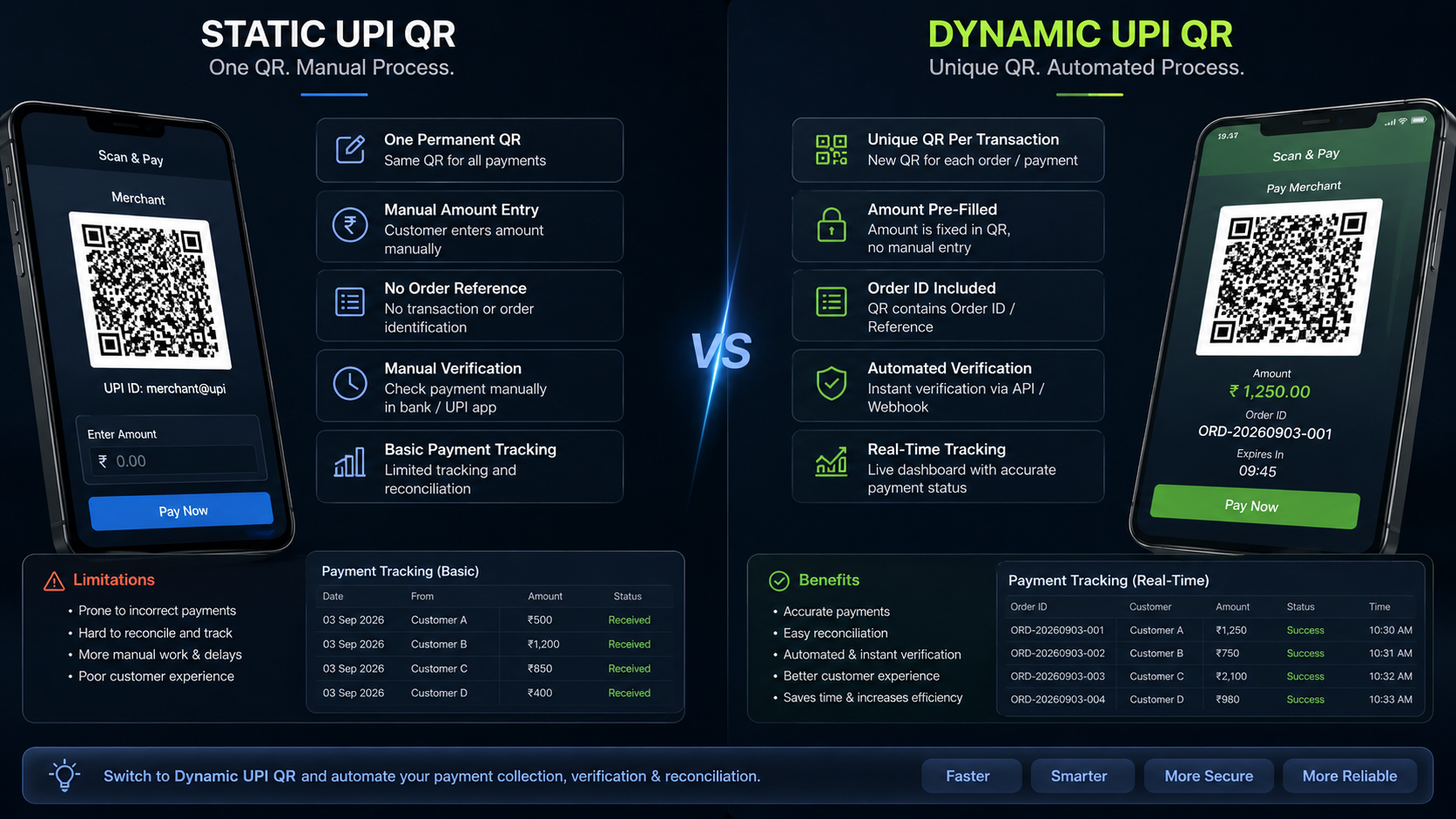
It depends on the business.
A static QR can be perfectly suitable for a physical shop or simple payment collection where customers can enter the amount themselves.
A dynamic QR becomes more useful when a business needs transaction-specific information and wants to connect payments with digital orders or automated reconciliation.
For an online business processing many individual orders, dynamic QR is generally the more suitable architecture.
Things Businesses Should Consider Before Implementing Dynamic UPI QR
Before implementing a UPI QR payment system, businesses should consider:
Merchant onboarding
UPI merchant acceptance involves the appropriate acquiring bank/authorized ecosystem participants. NPCI states that merchants need to partner with an acquiring bank to enable UPI.
Transaction verification
Don't mark an order as paid solely because a customer displays a screenshot.
Duplicate payments
The system should be able to identify repeated payments where applicable.
Failed transactions
A failed or pending transaction should not automatically be treated as successful.
Reconciliation
Transaction references and order IDs should be designed carefully.
Security
Payment status should be verified through trusted transaction information rather than user-submitted claims.
Compliance
Businesses should follow the applicable UPI, banking, acquiring and regulatory requirements for their business model.
Dynamic UPI QR Code: Best Use Cases
Dynamic UPI QR technology can be useful for:
E-commerce
Generate a payment request for each order.
Mobile Apps
Display a QR during checkout or payment confirmation.
SaaS Platforms
Connect payments with subscription or service orders.
Service Businesses
Create transaction-specific payment requests.
Online Booking
Associate payment information with individual bookings.
Digital Platforms
Automate payment-status workflows where the underlying payment infrastructure supports it.
Frequently Asked Questions
1. What is a Dynamic UPI QR Code?
A Dynamic UPI QR Code is a QR code generated for a specific payment transaction. It can contain payment-related information such as the merchant UPI address, transaction reference and amount.
2. What is the difference between Static and Dynamic UPI QR?
A static QR is generally reusable and can require the customer to enter the payment amount. A dynamic QR can be generated for a specific transaction and can carry transaction-specific information.
3. Can Dynamic UPI QR Codes include the payment amount?
Yes. NPCI's QR documentation includes an amount parameter for dynamic QR implementations, with the amount treated differently from static QR flows.
4. Can Dynamic QR help with payment verification?
Yes, when it is connected to an appropriate payment-status and reconciliation system. The QR itself does not independently verify whether money has been received.
5. Can I use Dynamic UPI QR on my website?
Yes, businesses can integrate QR-based UPI payment flows into online checkout experiences through appropriate merchant/acquiring infrastructure.
6. Can Dynamic UPI QR reduce manual payment checking?
It can help reduce manual work when the QR is connected to automated transaction-status and order-management workflows.
7. Is Dynamic UPI QR suitable for e-commerce?
Yes. It can be useful for e-commerce because individual payment requests can be associated with specific orders.
8. Does a Dynamic QR automatically confirm an order?
No. The website should verify the actual transaction status through the relevant payment infrastructure before marking an order as paid.
9. Can businesses generate a different QR for every order?
Yes, a dynamic QR implementation can generate transaction-specific QR codes instead of relying on one permanent QR.
10. Does UPI work 24/7?
UPI is designed for instant payments and is available around the clock, although individual transactions can still be affected by bank, app, network or technical issues.
11. Can Dynamic UPI QR be integrated with a mobile app?
Yes. QR-based payment is one of the UPI merchant integration modes described by NPCI, alongside intent and other modes.
12. Is Dynamic UPI QR the same as a payment gateway?
No. A QR code is a payment initiation mechanism. A payment gateway/payment aggregator and an acquiring/payment infrastructure arrangement involve broader services and regulatory responsibilities. Businesses should use the appropriate authorized infrastructure for their requirements.
Conclusion
A Dynamic UPI QR Code is more than just a scannable image. When properly integrated into a merchant payment workflow, it can connect a customer's payment with a specific order, transaction reference and amount.
For businesses, the biggest advantage comes from combining QR payments with payment verification, reconciliation and automation.
Instead of:
Customer Pays → Business Manually Checks → Order Updated
businesses can work toward:
Customer Pays → Transaction Verified → Payment Status Updated → Order Processed
That makes Dynamic UPI QR particularly valuable for modern websites, mobile applications and online businesses looking to create a faster and more organized payment experience.