How Merchant UPI ID Integration Can Simplify Online Payment Collection
In today's digital-first economy, UPI (Unified Payments Interface) has become one of the fastest, safest, and most widely used methods for collecting payments in India. Whether you run a small local business or manage a large e-commerce platform, integrating a Merchant UPI ID into your payment system can be a real game-changer.
In this blog, we'll break down what Merchant UPI ID integration means, how it works, and how it can simplify your entire payment collection process.
What Is a Merchant UPI ID?
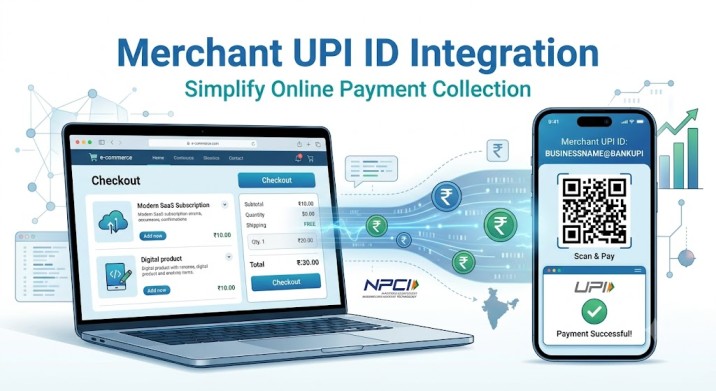
A Merchant UPI ID is a unique payment address registered specifically in the name of a business, such as businessname@bankupi. Unlike a personal UPI ID (used by individuals for day-to-day transactions), a Merchant UPI ID is designed exclusively for business transactions.
The biggest advantage of this is that it keeps your business finances separate from your personal transactions, making accounting, reconciliation, and tax filing significantly easier.

How Does Merchant UPI ID Integration Work?
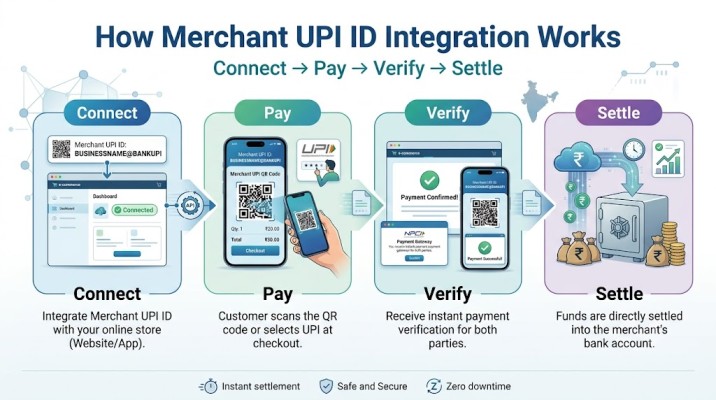
When a business integrates a Merchant UPI ID into its website, app, or POS system, the process typically works like this:
- Payment Gateway Setup – The business registers a Merchant UPI ID through its bank or a payment service provider (PSP).
- API Integration – The UPI ID is connected to the website or app's payment gateway via an API.
- Customer Payment – At checkout, the customer selects the UPI option and completes the payment by scanning a QR code or entering the UPI ID.
- Instant Confirmation – The payment is processed in real time, and both parties receive instant confirmation.
- Settlement – Funds are transferred directly to the business's bank account, usually within a very short time frame.
Benefits of Merchant UPI ID Integration
1. Fast and Instant Payments
UPI transactions are processed in real time. Customers receive confirmation immediately after payment, resulting in a smoother and faster checkout experience.
2. Lower Transaction Costs
Compared to credit cards and many third-party payment gateways, UPI transactions come with significantly lower charges — a major financial advantage for small and medium businesses.
3. Easy Reconciliation
All payments received through a Merchant UPI ID are tracked in a dedicated account, which makes accounting and reconciliation far simpler.
4. Multiple Payment Options
A Merchant UPI ID can be used via QR code, payment link, or direct UPI ID entry, giving customers flexibility in how they pay.
5. Builds Trust and Credibility
A verified Merchant UPI ID registered under the business name increases customer confidence, as it clearly shows they are paying a legitimate business.
6. Seamless Integration with Apps and Websites
Modern payment gateways offer APIs that are easy to integrate into websites and mobile apps, without requiring heavy technical setup.
7. Automatic Invoicing and Notifications
Many integration platforms automatically generate payment notifications, receipts, and invoices, reducing manual work for business owners.
Why Merchant UPI ID Matters for Your Business
Today's digital-first customers don't want cash payments or lengthy checkout processes. They expect payments to be quick, secure, and hassle-free. Merchant UPI ID integration helps businesses by:
- Reducing cart abandonment
- Improving customer satisfaction
- Minimizing payment failures
- Strengthening the business's digital presence
From small shops to large online stores, UPI has become a reliable payment solution for businesses of every size.
Things to Consider Before Integrating a Merchant UPI ID
-
Choose a trusted bank or payment service provider (PSP)
- Review the API documentation and integration support carefully
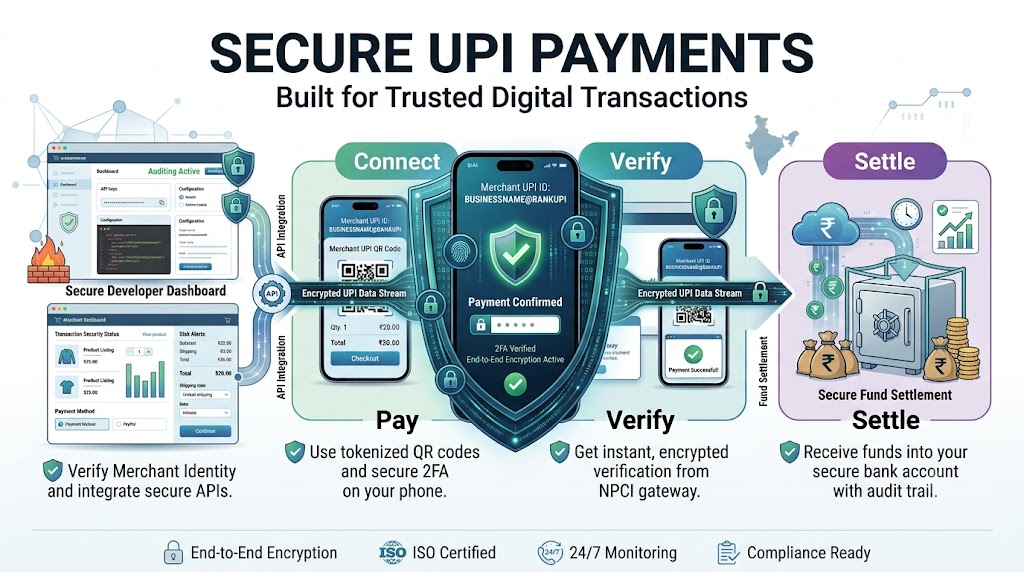
- Ensure compliance with security guidelines (such as NPCI regulations)
- Understand transaction limits and applicable charges in advance
- Confirm the customer support and dispute resolution process is clear
Conclusion
Merchant UPI ID integration isn't just a payment method — it's a smart financial tool that makes payment collection faster, safer, and more organized for any business. If you want to simplify online payments for your business, integrating a Merchant UPI ID is an essential step you should take as soon as possible.
FAQs (Frequently Asked Questions)
Q1. What is the difference between a Merchant UPI ID and a Personal UPI ID? A Personal UPI ID is meant for individual transactions, while a Merchant UPI ID is specifically created for business transactions. This helps keep business finances separate and organized.
Q2. Is GST registration required to get a Merchant UPI ID? GST registration isn't always mandatory for small businesses, but documentation requirements may vary depending on the bank or PSP's policies. It's best to confirm directly with your bank.
Q3. How long does Merchant UPI ID integration take? This depends on your payment provider and technical setup, but the process generally takes anywhere from a few days to about 1–2 weeks.
Q4. Can Merchant UPI ID accept international payments? No, UPI is currently designed only for domestic transactions within India. For international payments, businesses need separate payment gateways.
Q5. Is Merchant UPI ID integration secure? Yes, UPI transactions follow strict security protocols set by NPCI, including two-factor authentication and encrypted data transfer.
Q6. Can refunds be processed through a Merchant UPI ID? Yes, most payment gateways and banks offer an easy refund process through Merchant UPI ID, which is helpful for maintaining customer satisfaction.
Q7. What charges apply to Merchant UPI ID integration? Charges vary by provider, but generally UPI transactions carry a very low or, in many cases, zero MDR (Merchant Discount Rate), making it a cost-effective option for businesses.